Now enrolling cohort 04 · closes when full

100 men. 21 days. Rebuild stamina from the nervous system up.

A research-backed framework on the autonomic nervous system, the actual mechanism behind timing. From Dr. Daniel Hayes, PhD Behavioral Neuroscience, Stanford. Twelve years of clinical research. No supplements. No clinical jargon.

See the system →
Read by 4,000+ men Anonymous opt-in

30-day money-back guarantee on every paid tier. The risk is mine.

247men in the most recent cohort
21 daysaverage time to first measurable change
84%reported measurable change at day 21

Anonymous follow-up survey, Q1 2025 · n=247

Median latency improvement in the cohort: +94 seconds at day 21. Range: +47 to +180 seconds.

Worst case: 12 men reported no change. We refunded all of them, no questions, no exit survey, no friction. If the system does not work for you, the same applies. Honest data is the only data worth publishing.

311

of men under 40 deal with timing issues at some point. Almost none talk about it. Even fewer get accurate information.

The conversation no one starts

The most common thing men face. And the one with the worst information attached to it.

Most of what you find online is recycled forum advice, supplement marketing, or content written for clinical contexts that don't match your life. It misses the actual mechanism.

Timing is a function of the autonomic nervous system, specifically the interplay between sympathetic activation and vagal regulation. It is not a willpower problem. It is not a confidence problem. It is a wiring problem. And wiring can be trained.

Inside the free guide

Six things almost no one explains correctly.

A short, dense PDF you can read in 25 minutes. No fluff, no upsell wall, no clinical jargon. Just the framework. And what to do with it.

Why the “think about baseball” trick fails after 12 seconds

Behind timing is not psychology, it is vagal tone. Once you see the actual neurological mechanism, every distraction “tip” you have read makes sense, but most of them stop being useful by the second minute.

Why the stop-start technique fails in practice

The “stop-start technique” works in the lab but fails in practice. The modified protocol that fixes the design flaw (it has to do with attention placement, not breathing).

The four-second exhale rule (and why six is wrong)

A single autonomic intervention you can do anywhere, that down-regulates sympathetic activation in roughly 90 seconds. Cardiologists use a version of this for tachycardia, but the count matters more than most people think.

Why edging discipline alone doesn't transfer

The missing variable is not arousal management, it is interoceptive resolution. It determines whether what you train in private holds up in real situations, with another person, with the lights on.

Why day 14 feels like a failure (and why that's the proof it's working

What the literature on neuroplastic conditioning says about the 21-day rebuilding window: the dip near the midpoint is not regression, it is recalibration. The three signals you should track to know it is working.

The conversation you'll stop dreading

What changes for the partner who notices stamina recalibrating, often before you say a word, and the social pressure that fades when the body stops carrying it. The work focus, sleep, and conversational ease that come back when the nervous system stops bracing for failure.

The free guide is the first five chapters. The full framework, distilled into 12 pages.

Portrait of Dr. Daniel Hayes, PhD Behavioral Neuroscience, photographed in a library setting
Dr. Daniel Hayes · Stanford, 2024
Meet the author

Dr. Daniel J. Hayes, PhD

PhD in Behavioral Neuroscience from Stanford. MSc Cognitive Neuroscience from UCL. Twelve years of clinical research on the autonomic nervous system at the Stanford Autonomic Function Lab and, later, the Bay Area Neuroregulation Group.

Daniel left academia in 2022 to translate the research that never reaches the men who actually need it. Co-author of three peer-reviewed papers in the Journal of Sexual Medicine, including “Vagal Modulation and Ejaculatory Latency: A Polyvagal Framework” (2021).

I left the lab when I realized the most important research never reaches the men who need it. Helmsmen Lab is the bridge.Daniel J. Hayes, PhD
  • Stanford PhD 2010
  • UCL MSc 2007
  • 12 years clinical research
  • 3 peer-reviewed publications
  • Polyvagal-trained

P.S. Daniel does not see patients. Helmsmen Lab is education, not treatment.

47 peer-reviewed studiesUnderlying the framework
Masters & JohnsonSensate focus, adapted
Polyvagal theoryPorges, 2011
4,000+ readersTested in cohort
The path

How the system works.

Three phases. Twenty-one days for the core. The rest is consolidation.

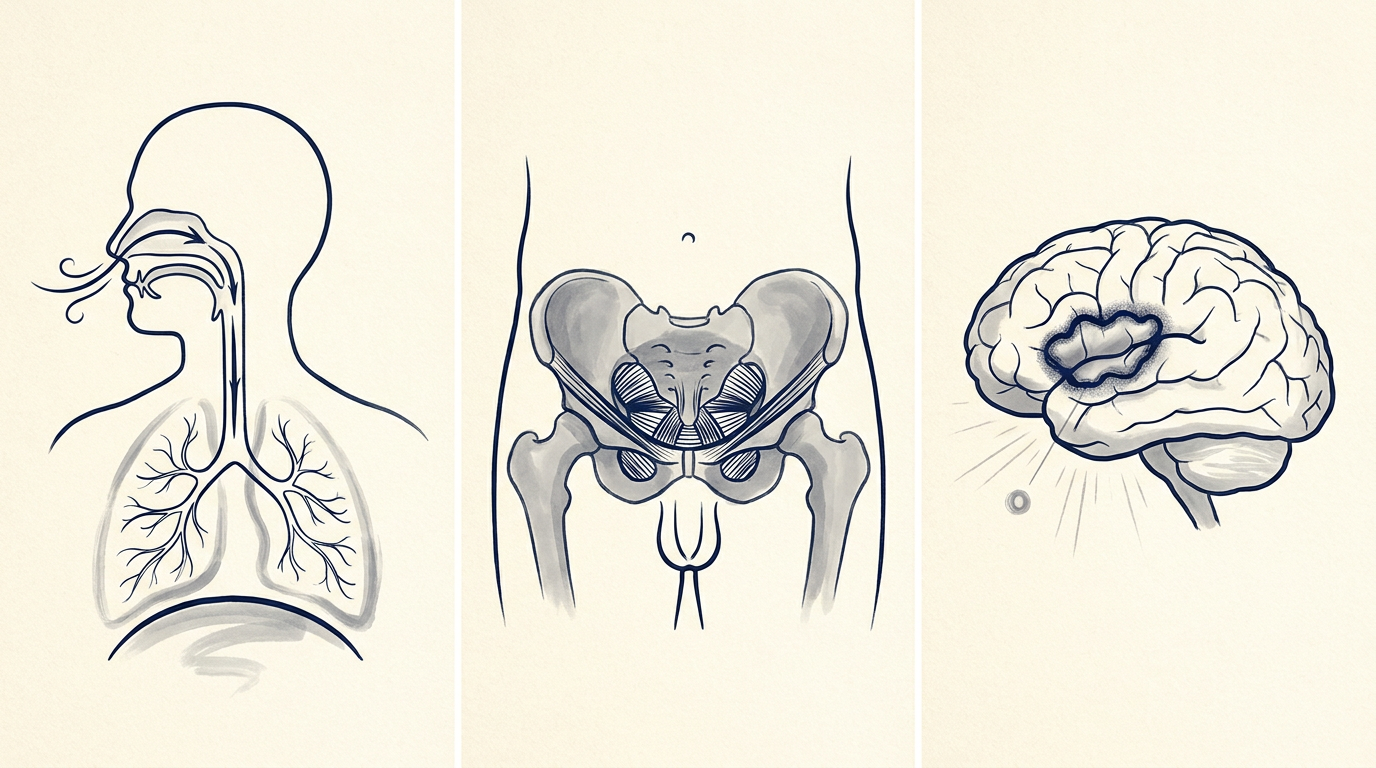
Triptych illustration showing the three physiological systems: respiratory diaphragm, pelvic floor, and brain insula
Figure 2 · The three physiological systems: respiratory, pelvic, insular
01

Map

You read the framework (chapters 1–5). You understand what's actually happening in your nervous system. No more guessing what the issue is.

02

Train

You run the four protocols (chapters 6–11). Breath, pelvic floor, attention, and the integrated session. Twenty-one days. Daily reps measured in single-digit minutes.

03

Integrate

You hold the threshold without thinking about it (chapters 12–15). Sleep, substrate, and the long view. The recalibration becomes how you operate, not what you do.

Reader notes

What men are saying.

Anonymous quotes from readers, used with permission. Initials and ages preserved.

Day 14 the countdown in my head was just… gone. I didn't notice when it stopped. That's what was strange about it.
MK
M.K., 34Software engineer, Austin
I came in skeptical. I have a PhD myself. The framework holds up, and the breathing protocol alone made a measurable difference inside a week.
JR
J.R., 41University researcher, Boston
My partner noticed before I did. I think that's the part I'll remember. Something I'd been carrying privately for years stopped being a thing.
AS
A.S., 29Architect, Brooklyn

Internal cohort, self-reported: 247 men, 21 days, 84% reported measurable change.

Want the first five chapters before deciding? The free guide is here.

More from the cohort

237 men. Thirty notes. One pattern.

A subset of follow-up survey responses received in the past 90 days. Identifying details changed; initials and ages preserved.

237 of 247 cohort members agreed to share these notes. The remaining 10 opted out. Identifying details changed. Full survey data on request.

The guarantee

Read it for 30 days. Run the protocol for 21.

If your threshold has not measurably improved by any honest metric you choose, write to support@helmsmenlab.com and I refund every cent.

You keep the workbook. You keep the audio. You keep the protocols. You keep the bibliography. You owe me nothing. No exit interview, no “reason for return,” no friction.

The risk is mine, not yours.

Daniel J. Hayes, PhD

When you are ready

The full system, three depths.

Start with the free guide. If it lands, this is where it goes next. No subscription, no upsell wall, though there is a small community if you want continuity).

The Letter

Start here

The first five chapters. The framework, distilled.

$141 stack value
$29
One-time · lifetime access
  • First 5 chapters (PDF + ePub)$47
  • Core framework + breath protocol$29
  • 21-day starter sequence (PDF)$29
  • 8-email letter series$19
  • Lifetime updates to The Letter$17
  • Stack value$141
You save$112 (79%)
Get The Letter · $29

Best for: men who want the framework first, before committing.

For the seriousThe Captain

With direct context

The Manual, a personalized baseline audit, and the implementation template.

$878 stack value
$249
One-time · lifetime access
  • Everything in The Manual$337
  • Notion implementation template$97
  • 30-min async personalized baseline audit$297
  • Priority cohort access (rolling, capped)$147
  • Stack value$878
You save$629 (72%)
Get The Captain · $249

Best for: men who want it audited against their specific baseline.

Or join The Crew (the anonymous community) for $14/month or $99/year. Continuity, not curriculum.

Feature comparison

What's included, side by side.

Same protocol. Different depth, different support.

The Letter $29

  • Core framework (first 5 chapters)
  • 21-day workbook
  • 8-email letter series
  • Full ebook · 67k words
  • Audio companion
  • Personalized baseline audit

The Captain $249

  • Everything in The Manual
  • Notion implementation template
  • Personalized baseline audit (30 min)
  • Priority cohort access
  • Lifetime updates
Open scientific journal with handwritten notes and a botanical diagram
The literature has been clear for two decades. What was missing was a translation that respected both the science and the man reading it.From the Helmsmen Lab field notes
Questions, answered

The ten things men actually ask.

If your question isn't here, write to support@helmsmenlab.com. Daniel reads every line.

Question answered? Start with the free guide, or go straight to The Manual.

Dr. Daniel Hayes
A note from Daniel

A note from Daniel

P.S.

If you've read this far, you're already in the top 15% of men who actually take action on this.

Most read three sentences and bounce. You read a wall, three case studies, the framework, the pricing breakdown, ten FAQs, and the guarantee. That signal alone tells me you're ready to do the work.

The free guide is 12 pages. Read it tonight. If something clicks, the Manual is here when you're ready. If nothing clicks, that's data too. I send no follow-ups except the 8-email letter series, and you can unsubscribe in two clicks.

Daniel J. Hayes, PhD

Free · Anonymous · 25 minutes

Start with the free guide.

A dense, science-backed PDF. Read once. Keep what's useful. If nothing else, you will never read another forum post the same way.

30-day money-back guarantee on every paid tier. The risk is mine.